Low-Impact Exercises You Can Do at Home
Low-impact exercise delivers all the major health benefits of physical activity without the joint stress associated with running or high-intensity training. For most adults, it is also the most sustainable form of exercise to maintain over years and decades.
What low-impact means and why it matters
Low-impact exercise is typically defined as movement in which at least one foot remains in contact with the ground or a stable surface at all times, minimising the repetitive impact forces transmitted through joints. Walking, swimming, cycling, rowing, and Pilates are classic examples. High-impact exercise — running, jumping, aerobics — subjects joints to forces two to three times body weight with each ground contact repetition.
The distinction matters most for people with joint sensitivity, those returning from injury, older adults building back activity, and people new to regular exercise whose connective tissues need time to adapt. It is also relevant for anyone who has tried and abandoned high-impact programmes — the attrition rate on running programmes among previously sedentary adults is high because the intensity and physical discomfort often represent too steep a starting gradient.
Walking as the foundation
Brisk walking — at a pace that elevates heart rate and breathing without making conversation difficult — meets the physical activity guidelines for cardiovascular health when performed for thirty minutes most days of the week. It requires no equipment, no instruction, no gym membership, and no specific prior fitness level. For the majority of adults, it is the single most accessible and sustainable form of exercise available.
The health evidence for walking is extensive and covers cardiovascular disease risk, metabolic health, bone density, mood, and cognitive function. Regular brisk walkers in large prospective cohort studies have substantially lower all-cause mortality than their sedentary counterparts, and the benefit accumulates even when walking is the only form of physical activity in the person's routine.
Bodyweight strength training at home
Strength training does not require a gym or any equipment. Bodyweight exercises — press-ups, squats, lunges, planks, glute bridges, step-ups onto a stable chair — produce the same adaptive muscular responses as equivalent resistance machine exercises when performed with sufficient effort. The progressive overload principle applies equally to bodyweight training through adding repetitions, slowing tempo, reducing rest periods, or progressing to harder exercise variations.
Consistent strength training twice per week maintains muscle mass, which tends to decline from the mid-thirties onward without specific stimulus. Preserving muscle mass supports metabolic health, functional independence as we age, and resilience against injury. Ten to twenty minutes twice per week, sustained over months and years, is substantially more beneficial than occasional intensive sessions followed by long gaps.
Yoga and Pilates for strength and mobility
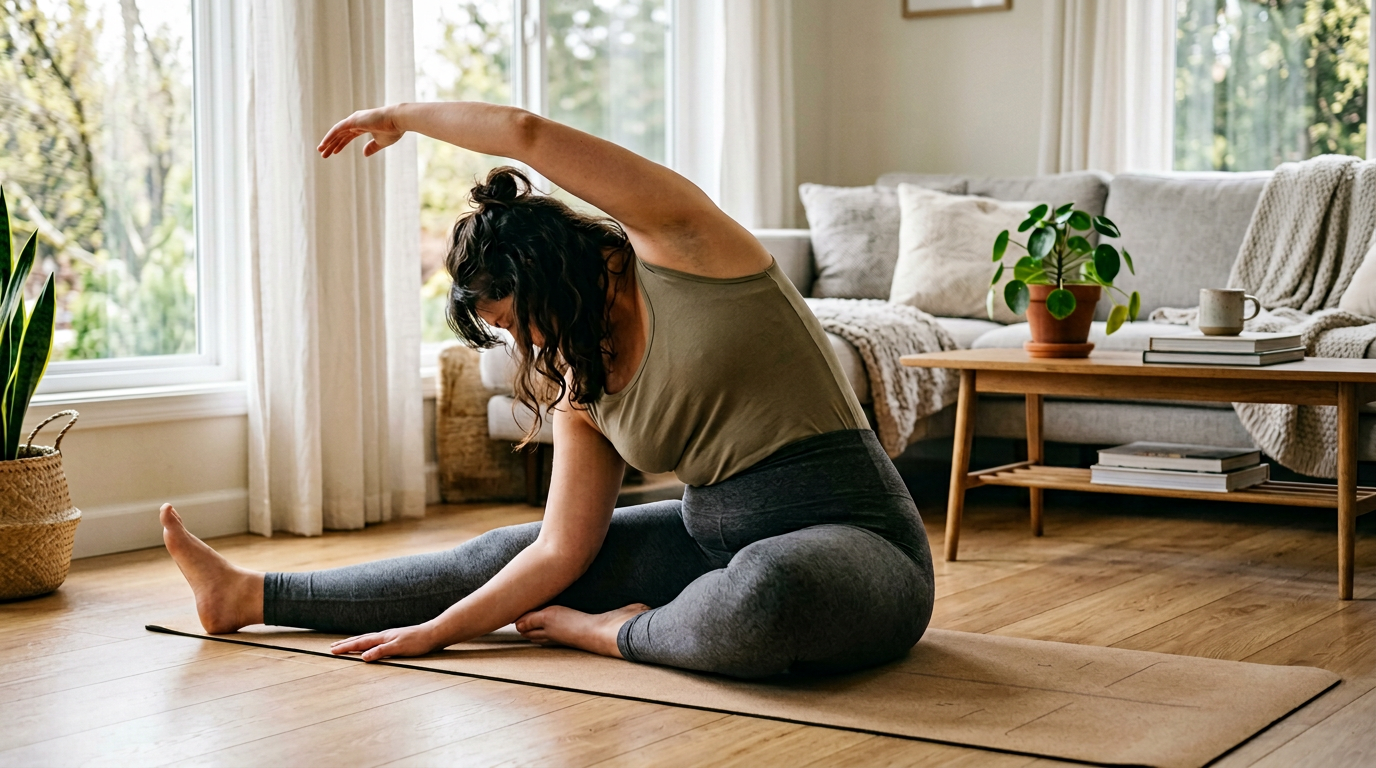
Yoga and Pilates offer a combination of flexibility, strength, balance, and body awareness not easily replicated by cardiovascular or conventional strength training alone. Both can be practised at home with minimal equipment using freely available resources — YouTube channels, apps, and public library digital borrowing cards that often include access to fitness platforms at no additional cost.
The evidence for both practices extends well beyond flexibility. Pilates is well-supported in research for chronic lower back pain management, and several yoga styles are associated with improvements in blood pressure, sleep quality, and anxiety measures. Choosing a difficulty level appropriate to current ability — beginner classes for those starting from scratch — prevents the injury and discouragement that come from attempting levels beyond current capacity.
Building a weekly movement structure
Combining several forms of low-impact exercise across a week produces broader physical benefits than any single type alone. Three or four brisk walks, two bodyweight strength sessions, and one yoga or mobility session constitute a genuinely comprehensive exercise programme completable in approximately four hours per week, predominantly at home or nearby without any commute or cost.
The practical challenge is scheduling rather than motivation. Blocking time for movement in the diary rather than fitting it around other commitments — treating it as a non-negotiable appointment — has a significantly higher completion rate than waiting for a spare moment to appear. Breaking each session into shorter segments when full sessions are genuinely not possible maintains the physiological stimulus more effectively than skipping entirely.
Key Takeaways
- Low-impact exercise produces equivalent cardiovascular and strength benefits to high-impact alternatives without joint stress.
- Brisk walking for thirty minutes most days meets cardiovascular health guidelines entirely and requires no equipment or cost.
- Bodyweight strength training twice weekly preserves muscle mass and functional capacity with no gym membership required.
- Yoga and Pilates provide mobility and strength benefits that walking and strength training alone do not replicate.
- Pre-schedule exercise as a diary appointment; movement that is planned has a significantly higher completion rate than movement that waits for a free moment.