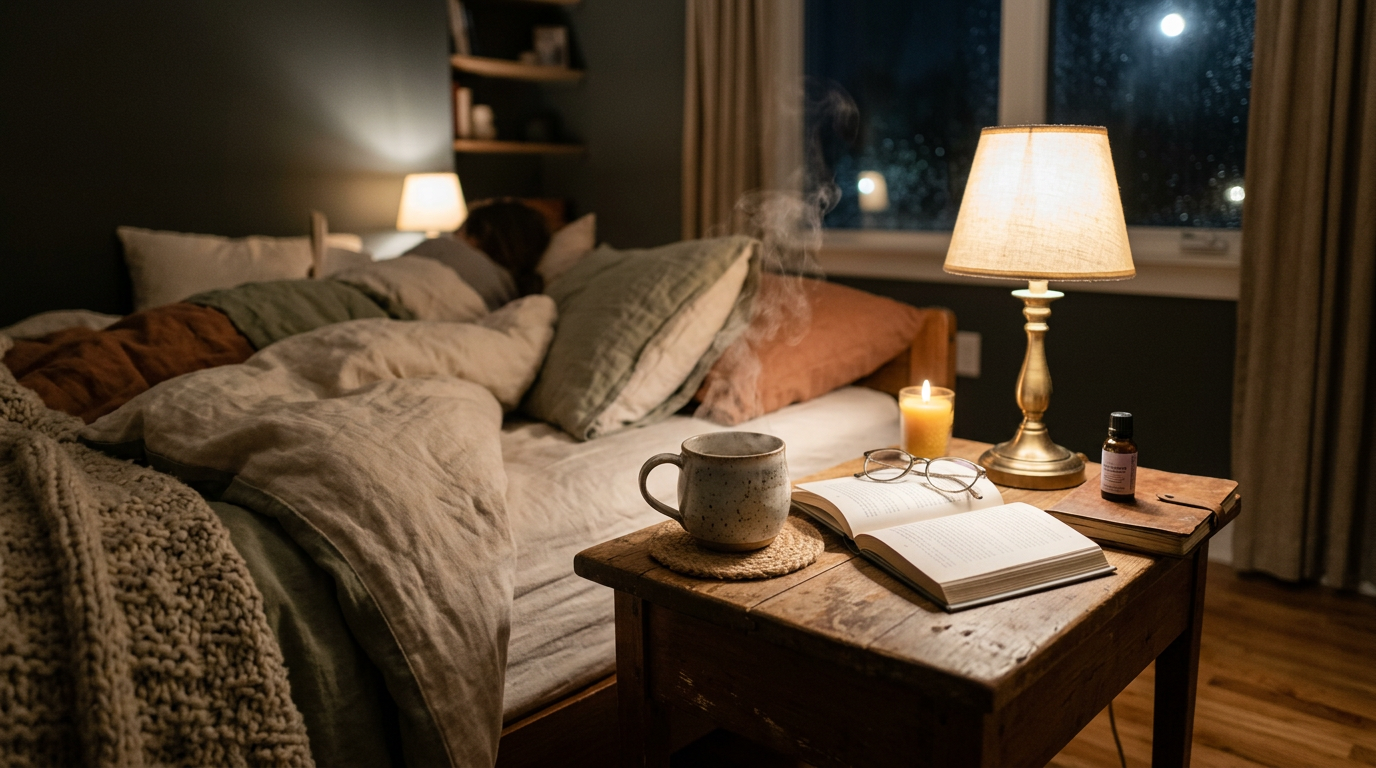
How to Build a Realistic Evening Wind-Down Routine
Most sleep advice focuses on the bedroom environment and the thirty minutes before bed. The more significant intervention is usually the two to three hours before that — the period when the body needs to be gradually signalled that sleep is approaching, not maintained in a state of alert stimulation.
Why the transition period matters
The body's transition from wakefulness to sleep is not a switch; it is a physiological process that requires time. Core body temperature needs to begin falling. Cortisol production needs to have subsided from its daily peak. Melatonin synthesis, which is suppressed by light exposure, needs to have begun accumulating. Stimulating activities — vigorous exercise, intense work, emotionally arousing content, screen-based social media — delay all of these processes simultaneously.
The practical implication is that a single pre-sleep ritual performed in the fifteen minutes before bed, however consistent, is working against two to three hours of signals pointing in the wrong direction. A realistic wind-down builds a gradient of decreasing stimulation across the whole evening rather than a sharp last-minute transition.
Light management in the evening
Bright light, particularly in the blue wavelength range, is the most potent suppressor of melatonin production. Modern LED lighting and screens emit substantially more blue light than older incandescent sources. Reducing light intensity in the home during the evening — using lamps rather than overhead lighting, turning off unused lights after 8 or 9pm — supports the natural melatonin rise that precedes healthy sleep onset.
Screen warm-tone settings on phones and computers reduce but do not eliminate the blue light effect. The content being consumed on screens also matters independently of the light itself — emotionally arousing or intellectually stimulating content produces cortisol and adrenaline responses that counteract physiological preparation for sleep regardless of how warm the screen colour temperature is set.
Temperature and its role in sleep onset
A modest drop in core body temperature is both a signal and a facilitator of sleep onset. A cool bedroom — typically between 16 and 19 degrees Celsius for most adults — supports this drop and is one of the most consistent environmental predictors of sleep quality. A warm bath or shower taken thirty to sixty minutes before bed has a counterintuitive but well-documented effect: the subsequent cooling of the body after stepping out accelerates the temperature drop that facilitates falling asleep.
Avoiding heavy meals, alcohol, and vigorous exercise in the two to three hours before bed removes three common obstacles to the temperature drop. Alcohol in particular disrupts the second half of the night's sleep architecture even when it appears to assist initial sleep onset — the net effect on sleep quality is negative in almost all controlled studies.
Building a sustainable routine
Prescriptive wind-down routines with seven specific steps performed in a fixed order fail for most people not because the individual steps are wrong but because the rigidity cannot survive the variability of real life. A more sustainable approach identifies the two or three elements with the strongest evidence and treats everything else as optional.
Fixed commitments that are easy to maintain on most evenings — dimming lights after a certain time, avoiding screens for the last hour, not eating after a set time — are more valuable than elaborate rituals requiring exceptional circumstances to complete. Start with one change, allow it to become automatic over three to four weeks, then add a second. This sequential approach produces lasting habit change more reliably than comprehensive overhauls.
Managing the overactive mind
For many people, the barrier to sleep is cognitive rather than physiological: intrusive thoughts, planning, rehearsing, ruminating. Addressing this requires a deliberate cognitive wind-down alongside the physiological one. A brief structured "brain dump" — writing tomorrow's tasks and unresolved concerns in a notebook for five minutes before bed — externalises the material that would otherwise circulate in working memory during the night.
The research on this technique is consistent: externalising plans and concerns onto paper reduces the frequency of intrusive thoughts and the time to sleep onset compared to control conditions. The notebook does not need to be elaborate — five minutes of writing what is on your mind is sufficient to achieve the cognitive unloading effect that makes the mental transition to sleep easier.
Key Takeaways
- Build a decreasing-stimulation gradient over two to three evening hours rather than relying on a single last-minute ritual.
- Reduce bright and blue-spectrum light from 8–9pm onward using lamps rather than overhead lighting.
- A warm bath thirty to sixty minutes before bed accelerates the body temperature drop that facilitates sleep onset.
- Start with one or two sustainable changes as defaults rather than an elaborate multi-step routine.
- A five-minute brain dump — writing concerns and tomorrow's plans — measurably reduces intrusive thoughts at night.